Palmer started selling modernized handhelds under the name "ModRetro" pretty early last year. My mom got me one of these for Christmas, and she was able to find my old stash of games from when I was a kid, which included Pokemon Silver. The screen quality/brightness on the Chromatic is pretty amazing compared to my old Game Boy Color, and I was hoping to be able to play some of my old games.
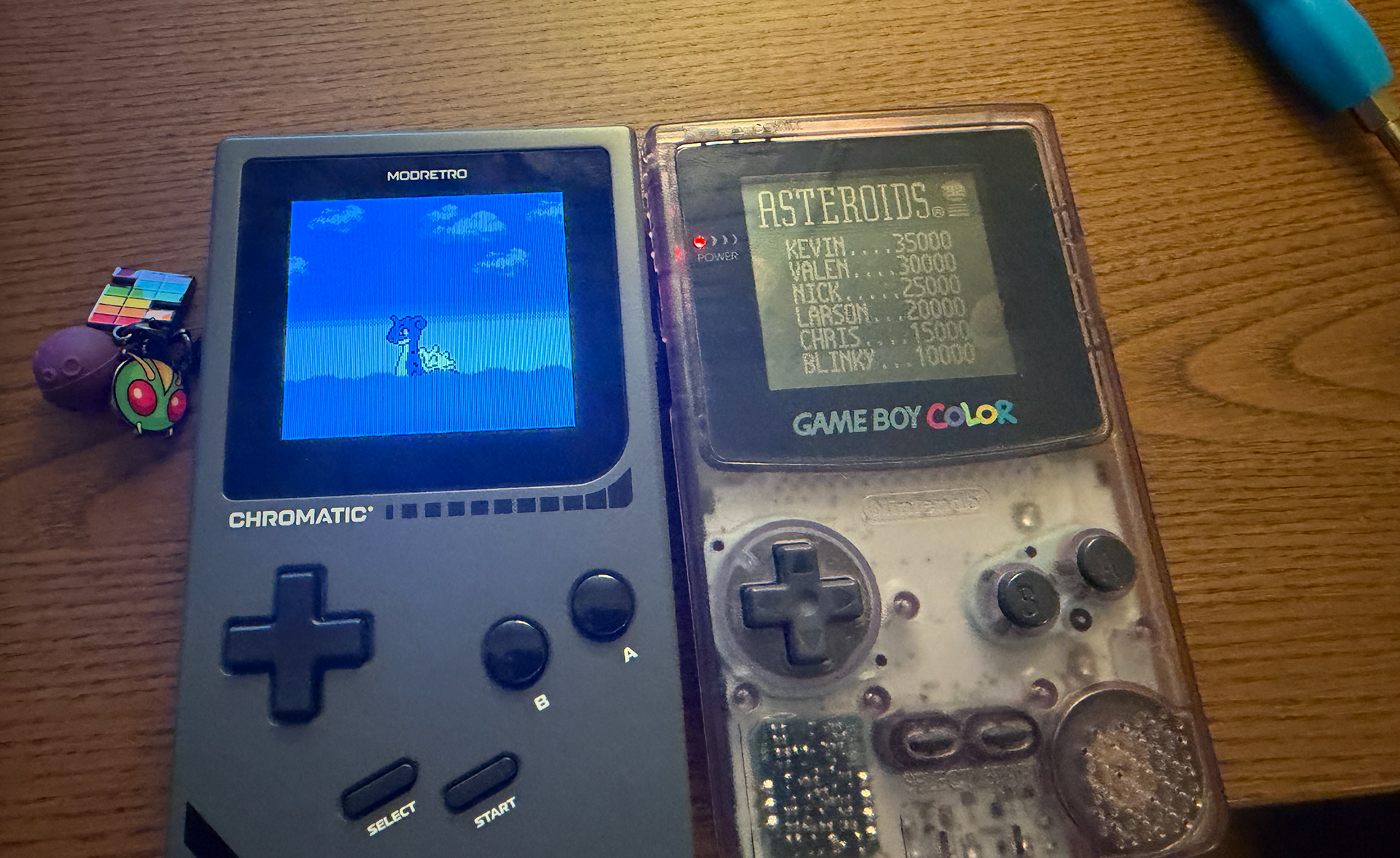
Unfortunately, not only were all of my old save files gone, but the save state functionality was broken on pretty much every cartridge. Thinking that the cartridges were broken, I started looking for replacement copies online.... much more expensive than I had imagined.

DKOldies listing for a used cartridge only (no case, out-of-box)

Sealed copies are a tad more expensive
After a little bit of googling, I realized that it was likely a dead battery internal to each of the cartridges. Flash-type memory was slow and prohibitively expensive in 1999, so all of the original Game Boy Color cartridges rely on volatile memory (SRAM) continuously powered by a small coin cell within each cartridge. Supposedly these batteries are able to last for somewhere between 10-15 years, but as of today my cartridges are about 25 years old, so this was likely the problem.
Pokemon Silver Cartridge Teardown
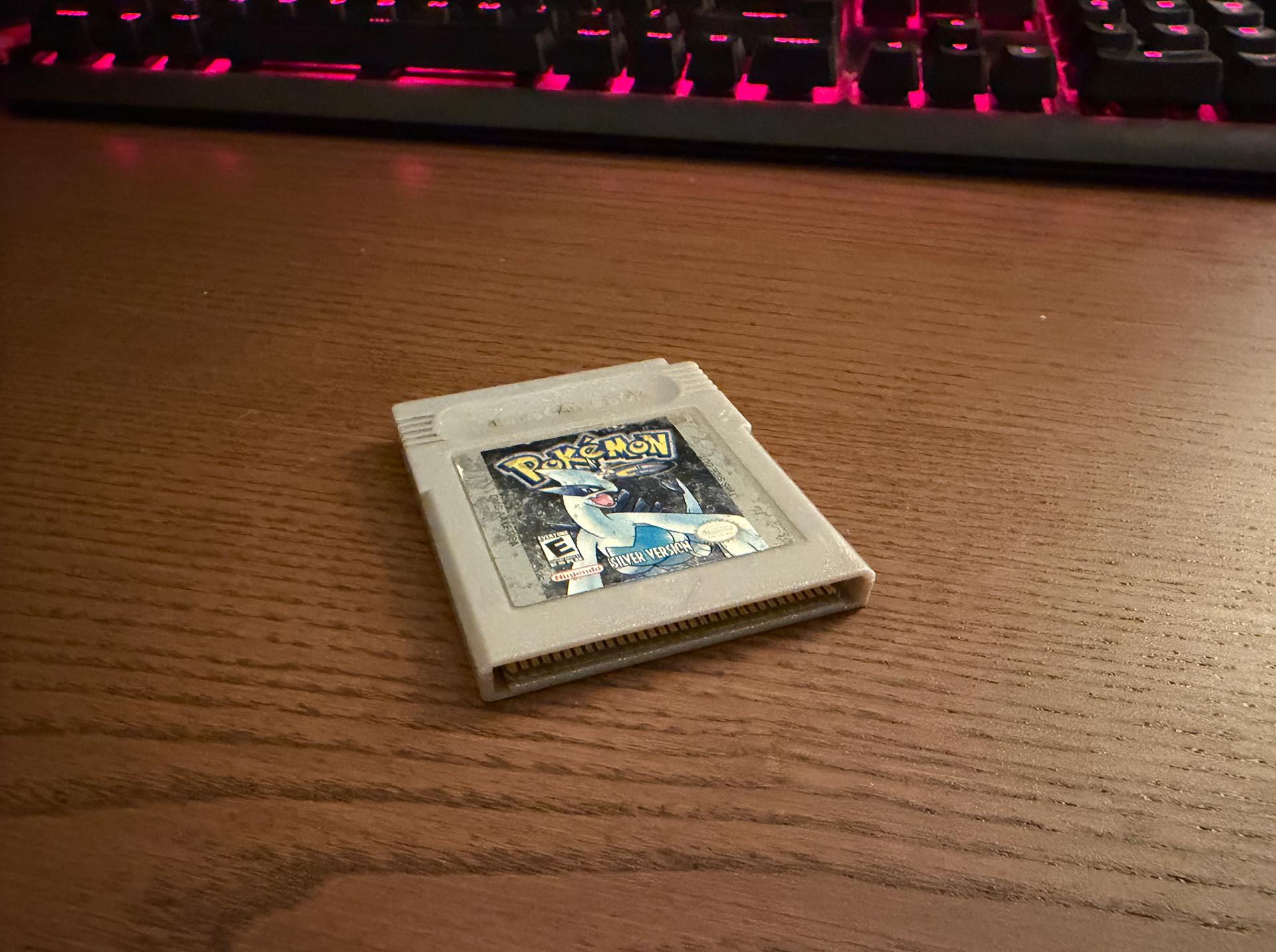
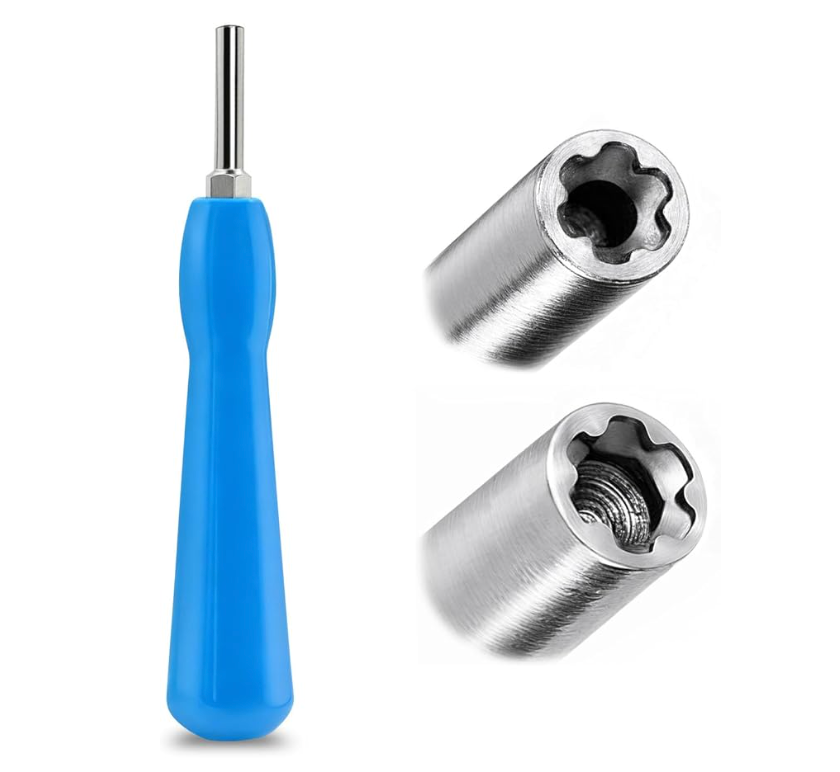
I started by taking off the cover of the Pokemon Silver cartridge. It's secured by a small 3.8mm security screw, which is removed using a specialty "Gamebit" screwdriver, which I was able to find on Amazon for $5. The shape of the head looks very similar to a male version of Torx Plus, and is not a head shape that I've seen anywhere else.
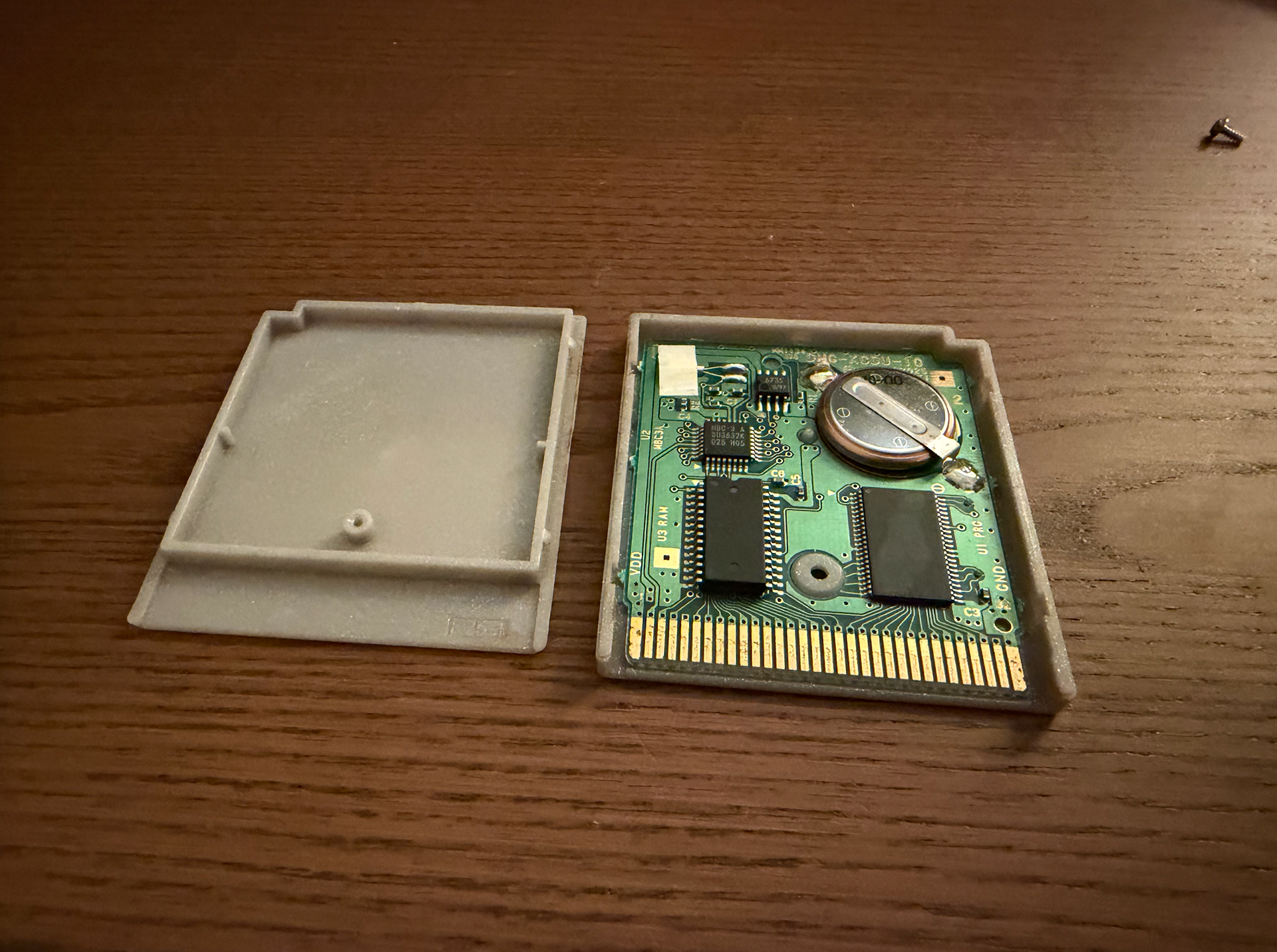
Split of the Pokemon Silver Cartridge
The inside of the cartridge was pretty much immaculate, except for a little bit of tarnishing on the contacts and dust around the edges of the board.
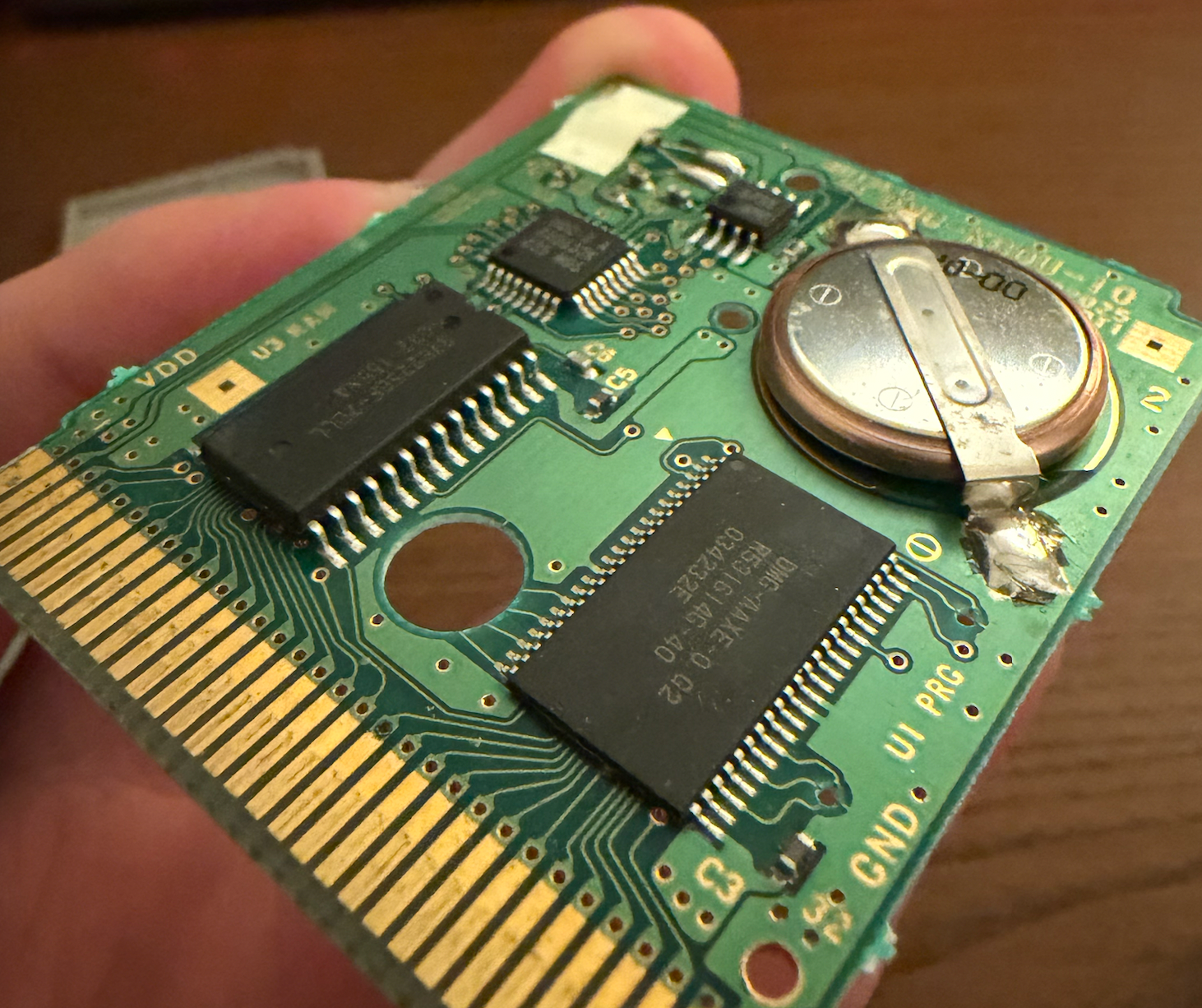
Top-side of the Pokemon Silver PCBA
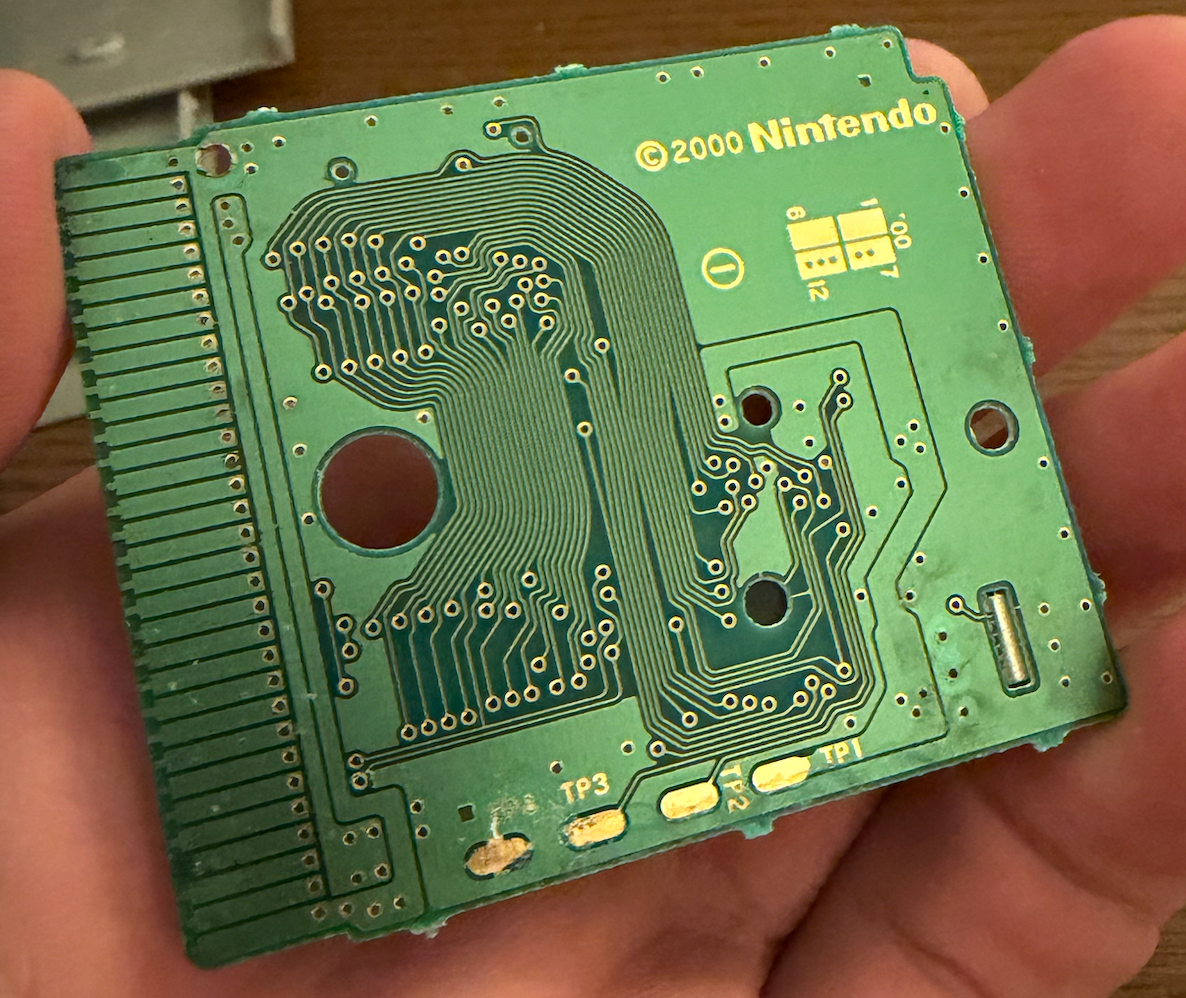
Under-side of the Pokemon Silver PCBA
There are a few interesting things on these cartridges, but they are pretty damn simple.
The largest chip, labeled "DMG-AAXE-0 G2; R531614G-40; 034232E", seems to be the ROM chip, which contains the instructions for this particular game. As a non-EE, my understanding is that read-only memory was substantially easier to make non-volatile/persistent because it was burned into the chip (Mask ROM). The data was inherent to the structure of the chip, and no power was needed to stabilize the state of each bit. Just hardwired 1s and 0s. This also means that these chips aren't reprogrammable.
The square chip in the middle, labeled "MBC-3 A; BU3632K; 025 H05," is the memory bank controller. Again, as a non-EE, my understanding is that the Game Boy Color could only access so much data at once, so this chip split the game into multiple chunks that could be switched between. It also contains a real-time clock, which is used in Pokemon for tracking the time of day. Some Pokemon can only be caught at specific times!
The taller chip underneath it is labeled "BR62256F-70LL; 032 55NA." This is the SRAM chip, which is the part responsible for handling game data. It has a handful of traces running to the last small chip at the top labeled "6735; 0797" which seems to be something called a "RAM protector," which handles glitches and power supply changes when inserting/removing cartridges.
Lastly, there is the coin cell, which is labeled "CR2025." It's a low-voltage (~3V) cell used in key fobs and such, and is supposed to be rated for long-term use. It keeps the SRAM alive until the cartridge is inserted into a handheld, at which point the handheld's onboard power (5V) kicks in.
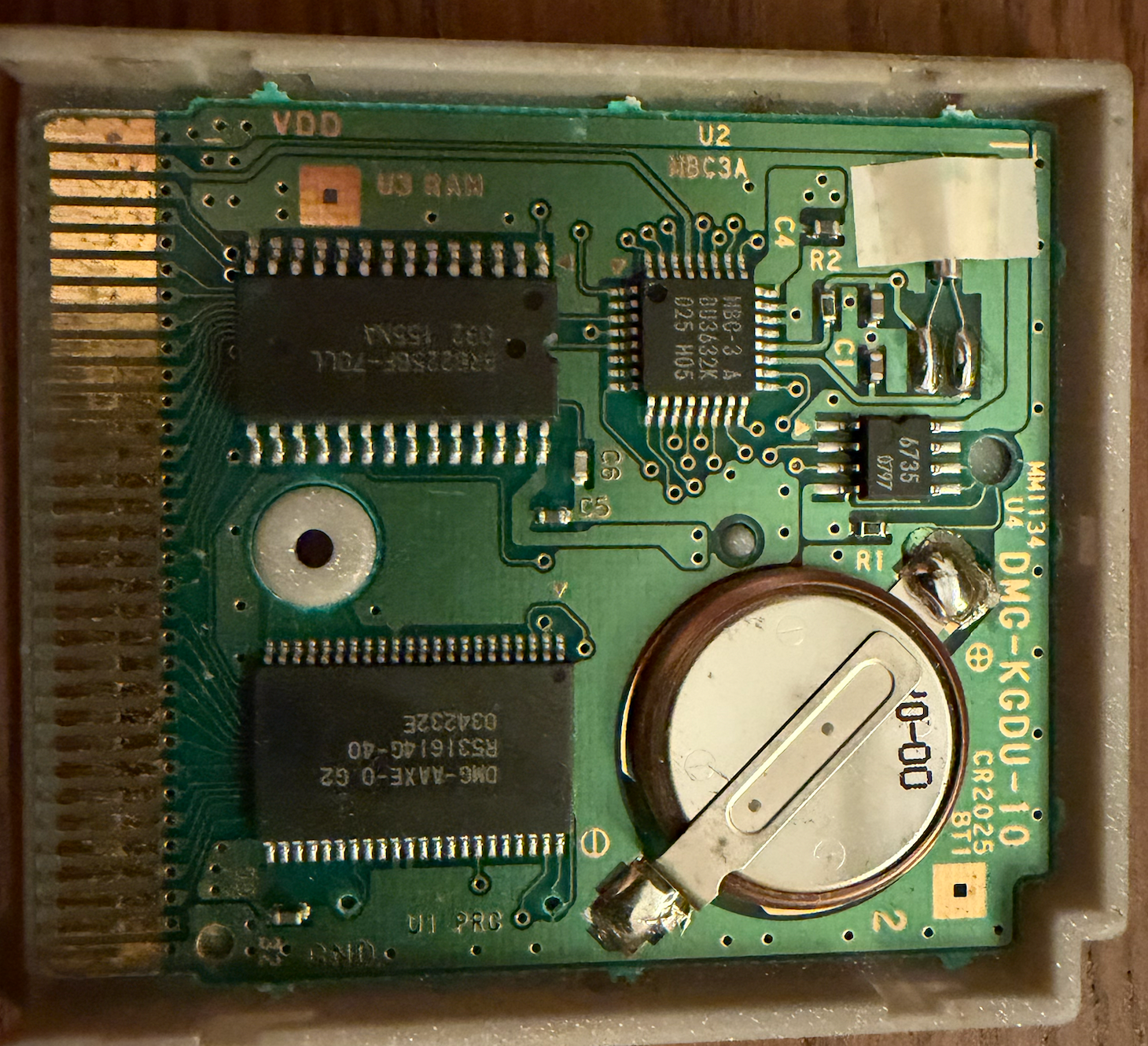
Old Battery
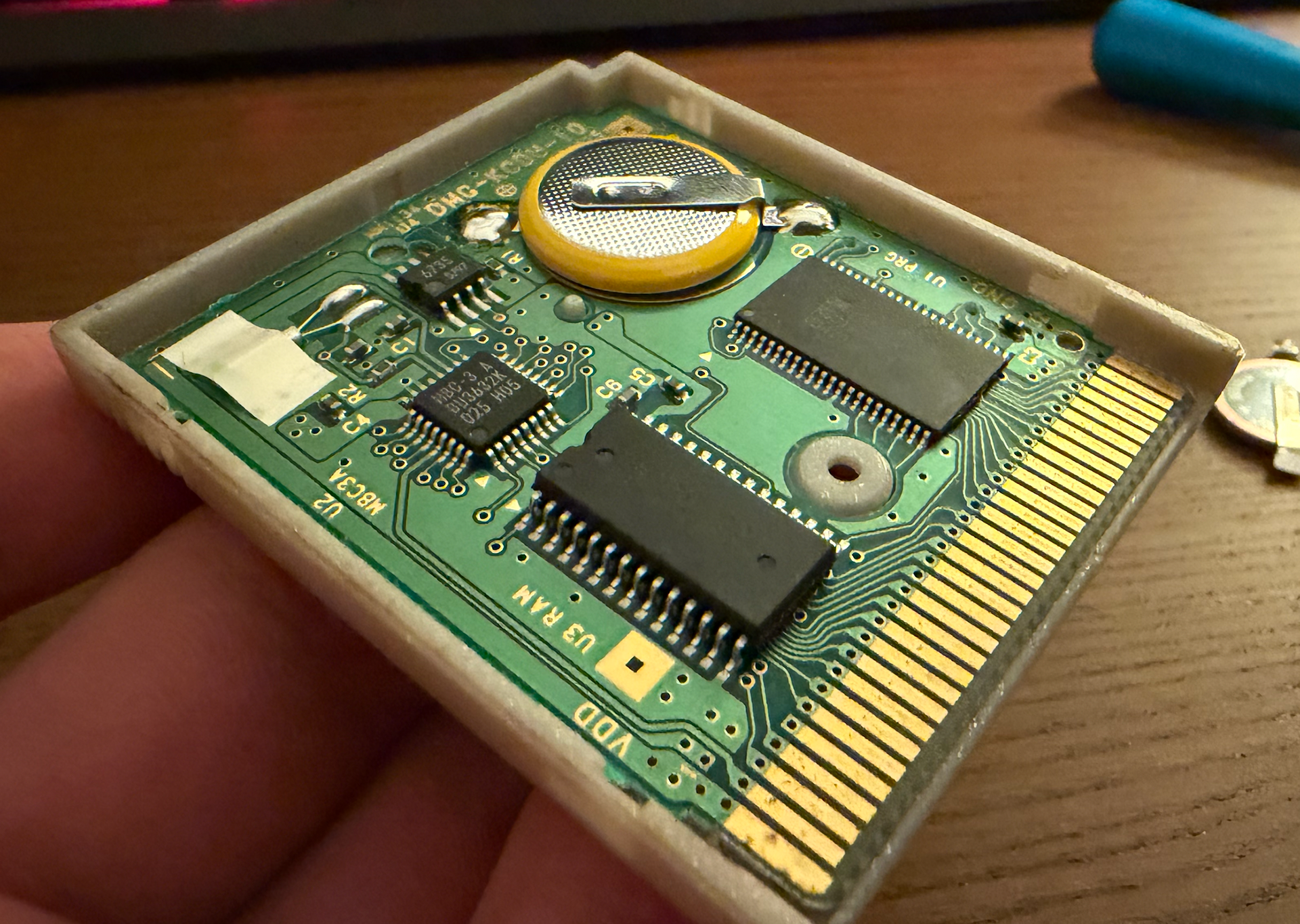
New Battery
Using a multimeter, I measured the voltage on the battery that was in place and read a value to the tune of 0.1 volts, confirming that it was dead. I desoldered the battery and ordered some more of these cells from Amazon for about $1/pc. It was quick to solder a new one back in place, and this solved the problem!
One thing of note is that the Chromatic seems to struggle with this cartridge in ways that my original Game Boy Color does not -- if the cartridge is inserted before power is turned on, it occasionally fails to boot or boots with inverted colors. I tried cleaning the contacts, but this didn't really solve the problem. Very strange, but a simple fix is to just power the device on before inserting the cartridge.
I did not see this problem with any other games, ModRetro or original GBC, for what it's worth.
Testing Save States
ModRetro "Tetris" Cartridge Teardown
With access to the proper tools, I figured I'd open up a modern take on the Game Boy cartridge. There are several tear-downs of the Chromatic itself online, but nothing on the re-releases that ModRetro sells.
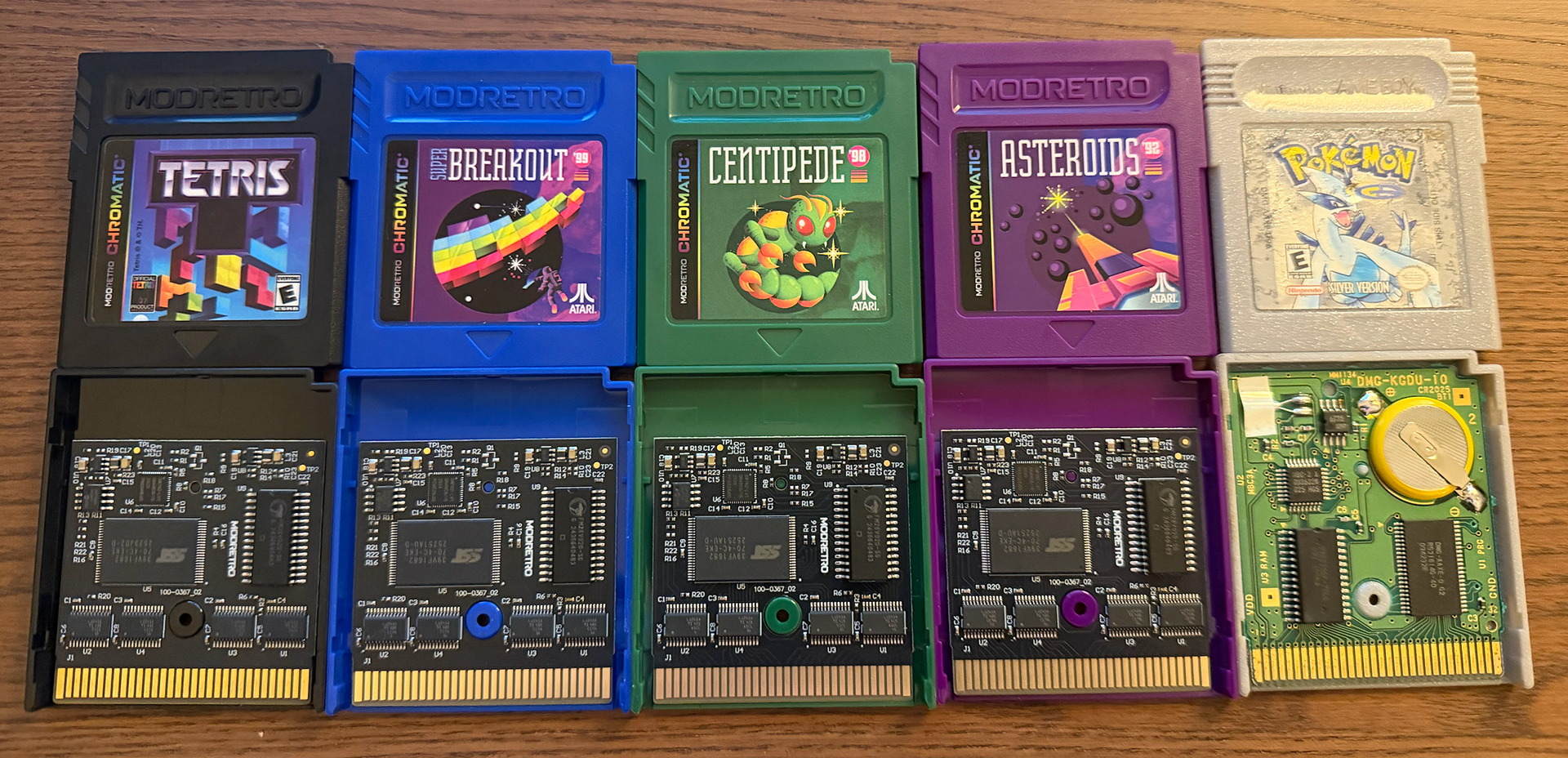
The PCBAs inside the cartridges are slightly smaller in form factor than the originals, but they share the same alignment features. The ModRetro cartridge housings are slightly thinner, but all of the major internal features are the same. Taking the cartridge apart was the same process as the original.
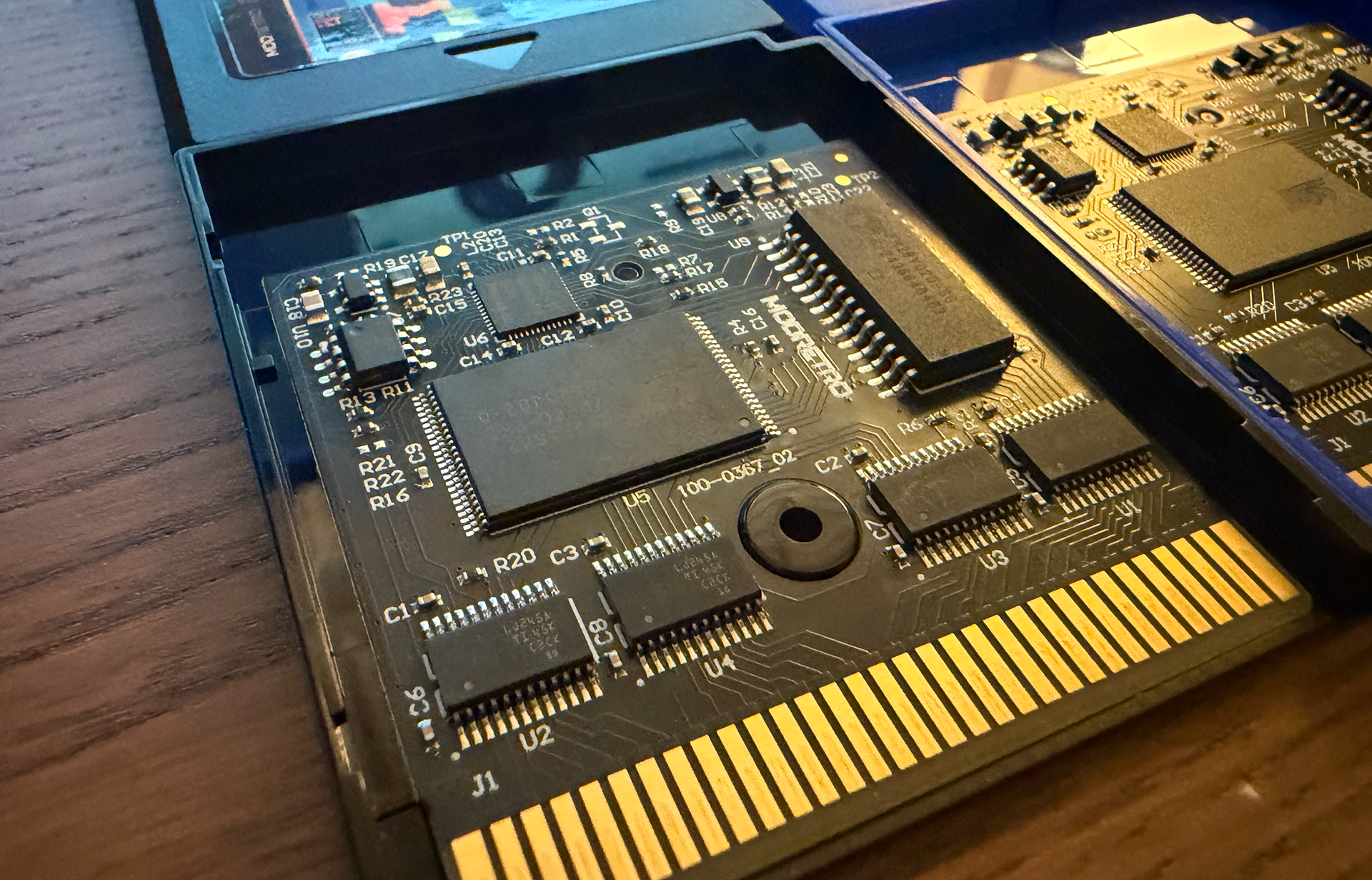
ModRetro "Tetris"
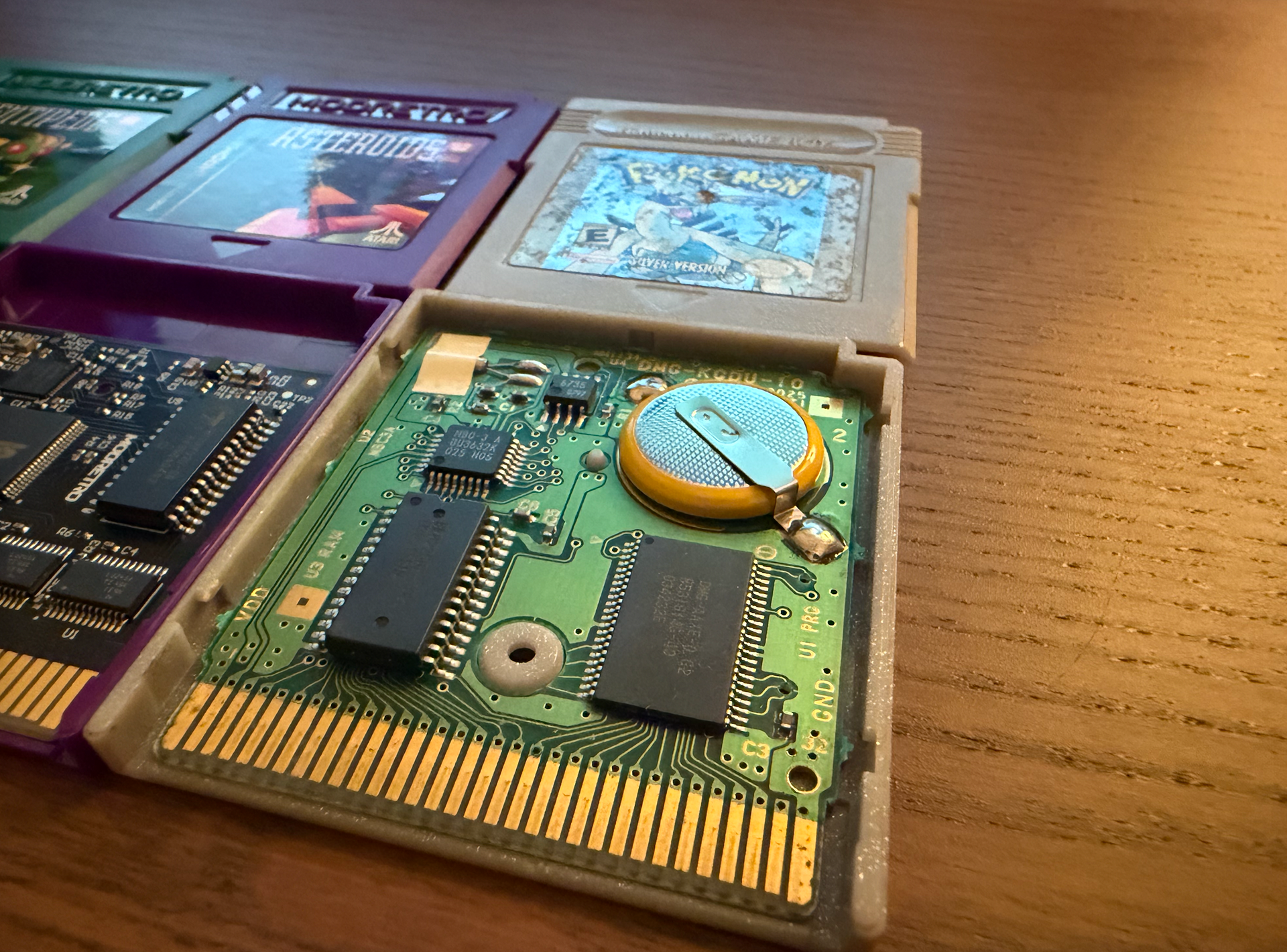
Game Boy Color "Pokemon Silver"
The largest chip, labeled "39VF1682; 70-4C-EKE; 2523JD2-D" is the flash memory, which I believe is replacing the ROM chip on original cartridges. Because it is not read-only, I assume that the PCBAs for ModRetro games are all identical, and are just reprogrammed for each of the games they sell. This also means that cartridges can probably be updated/reflashed! This chip has a size of 2 MB, which is a typical size for the original GBC ROM chip.
Next to it is a tall chip labeled "FM28V020-SG; G 2436640483," which is FRAM. I believe this chip is replacing the SRAM and coin cell on original cartridges. This chip has 32 KB of non-volatile memory, which is a typical size for the original GBC SRAM chip.
Up top, there is an FPGA labeled "GW1NZ-LV1; QN48C6/15; 2423; PNG348.00," which likely handles a good deal of the functionality of the memory bank controller, and a small chip labeled "26F020A; SN2511," which is 256 KB of SQI flash memory that seems to be dedicated to the FPGA. It's not obvious to me as a layman what this memory is being used for.
Finally, there are four bus transceivers that intercept the signals between the contacts on the cartridge and the internal chips -- it seems like these are being used as level shifters to step down from 5V (handheld-side) to 3.3V (cartridge-side). I'd assume this is because the original GB/GBC cartridges ran on 5V, and doing this enables backwards/forwards compatibility.
All together, the ModRetro re-release boards appear to be quite nice -- they're designed to the typical specifications of Game Boy Color games and are backwards compatible with original devices. I'm not certain, but it also seems like they might be reprogrammable, which I might try doing next.
Thank you for not filling these with black epoxy/potting.